
The A-Z of Government Contract Vehicles: Bridging the Gap between Public Needs and Private Expertise

What are Government Contract Vehicles?
Collaboration between industry, academia, and the government is essential for driving national progress in innovation and technological advancement. These partnerships accelerate the development of new technologies and foster economic growth and societal benefits. Acquisition vehicles serve as the mechanism for government to access innovative solutions developed through private ingenuity and academic.
Acquisition vehicles are the way the government obtains goods and services from the private sector. They are designed to simplify and enhance the procurement process, contribute to healthy competition within industry, and adhere to established regulations.
However, not all contract vehicles are the same and each has its own set of characteristics and purposes. Understanding the differences is essential to enabling individuals and organizations to make informed decisions when navigating the complexities of entering into a contractual obligation with the United States government.
Contract Vehicles VS. Agreements
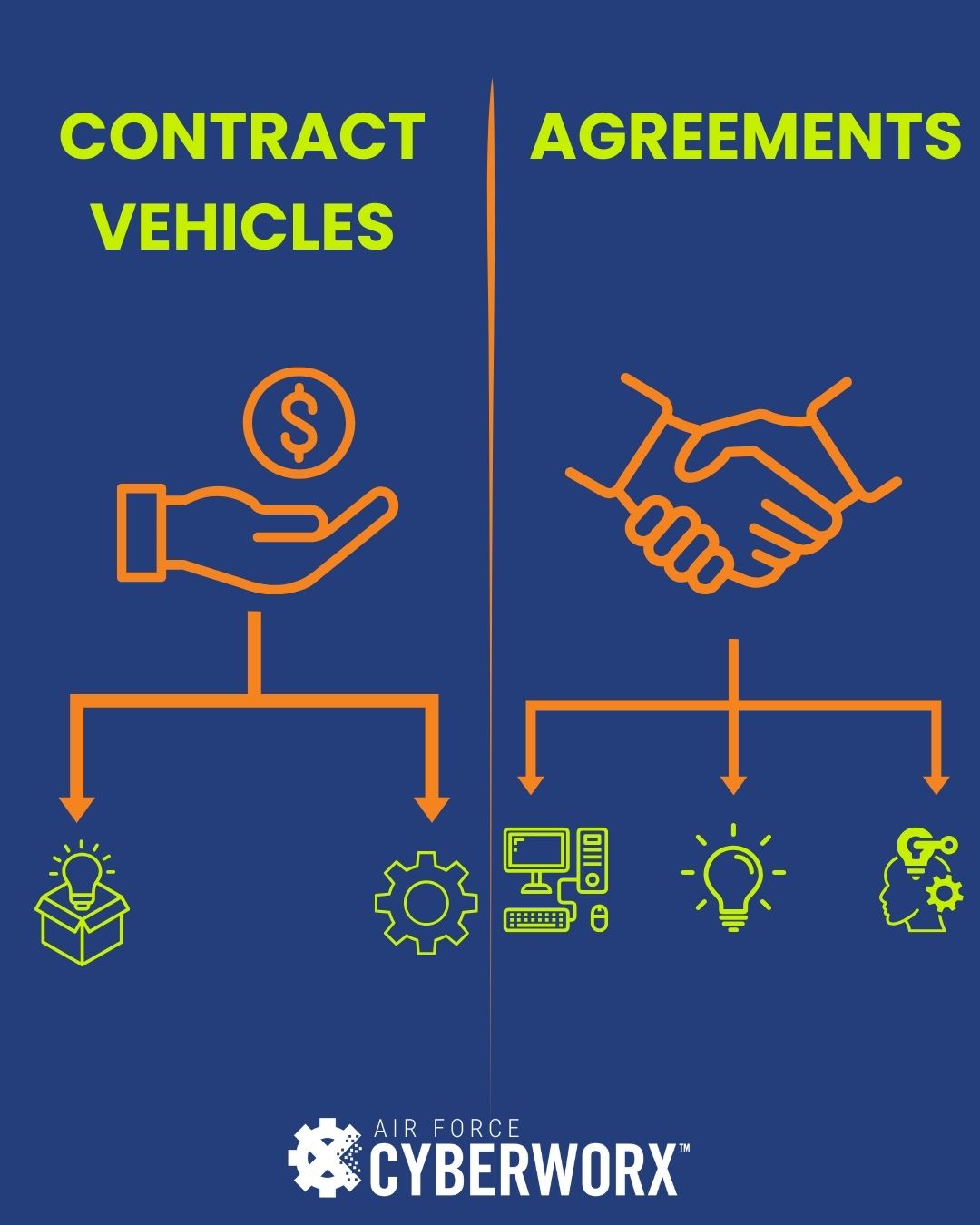
On the surface, the terms “contract vehicle” and “agreement” may seem interchangeable, but there are some nontrivial distinctions that should be considered when developing an acquisition strategy. Grants and agreements are government assistance mechanisms. Agreements can be used to share intellectual property, expertise, facilities and equipment and work collaboratively on a project without financial obligation. Contracts involve the exchange of money for goods and services.
Contract Types
FAR-Based Contracts
Federal Acquisition Regulations, or Far-Based contracts, comprise the majority of government contracts. These contracts are competitive and adhere to the Federal Acquisition Regulations and departmental supplements jointly supervised by the Department of Defense (DoD), General Services Administration (GSA), and National Aeronautics and Space Administration (NASA). FAR-Based contracts are used to procure services or products for the benefit of the government, and the clauses are used to detail how involved parties must manage their contracts and deliverables.
Below are examples of various types FAR-Based contracts.
Examples of FAR-Based Contracts:
Small Business Innovation Research (SBIR) and Small Business Technology Transfer (STTR)
Tactical Funding Instrument (TACFI) and Strategic Funding Instrument (STRATFI)
Commercial Solutions Opening (CSO)
Broad Agency Announcement (BAA)
SBIR/STTR
The Small Business Innovation Research (SBIR) and Small Business Technology Transfer (STTR) programs are designed to further technological advancement by encouraging small businesses to work with the federal government. These programs offer nondilutive funding opportunities for small businesses to develop technologies relevant to the DoD and government agencies using these acquisition pathways. SBIR/STTR programs propel technological advancements and provide necessary resources to small businesses as they mature technologies for possible government use. Most importantly, companies retain their intellectual property rights and are eligible for sole source contracts after the award of a Phase I or II SBIR/STTR.
A key feature of the STTR program is the requirement for a small business to partner with a research institute, such as Catalyst Campus for Technology and Innovation, the Partnership Intermediary Agreement (PIA) supporting Air Force CyberWorx. PIAs can be also universities or non-profit research entities. This partnership allows companies to access deep subject matter expertise, equipment, and test artifacts they may have difficulty obtaining in their business.
TACFI/STRATFI
Tactical Funding Instrument (TACFI) and Strategic Funding Instrument (STRATFI) are Department of Air Force specialized contract vehicles used to rapidly acquire innovative solutions and technologies in an effort to bridge the “Valley of Death.”
TACFI is designed to support tactical-level, near-term projects with quicker turnaround times, enabling fast prototyping and experimentation at the operational edge. In contrast, STRATFI focuses on strategic, longer-term initiatives that require more substantial investments and broader impact across the Air Force mission. Together, these instruments streamline the contracting process.
CSO
A Commercial Solutions Opening (CSO) is another competition mechanism the government can use to rapidly engage industry for commercial technology, resulting in a FAR-based Firm Fixed Price contract. CSOs are used to acquire new solutions or technologies in many cases already in use in the commercial sector to fill requirements or gaps for the DoD. CSOs are a streamlined acquisition approach that is designed to be collaborative with the vendor, and more akin to a business-to-business contract than traditional acquisitions.
BAA
Broad Agency Announcements (BAAs) are very similar to CSOs, but target early-stage development, and require a public good. While a CSO can be used to procure commercial technology or services for program needs, BAAs are limited to funding basic and applied research through grants, agreements, and research and development contracts. The purpose of a BAA is to explore early-stage ideas and drive innovation. White papers can be submitted and evaluated for technical merit and feasibility. BAA submissions can be from small or large companies.
OTAs & Non-FAR-Based Contracts
Other Transaction Authoritys (OTA), also referred to as OTs, are not a FAR-Based contract. Occasionally, the DoD requires R&D projects from the commercial sector and require more flexibility than a FAR-Based contract. In these instances, an OTA may be a better option.
As OTAs are not governed by the Federal Acquisition Regulation, they are not required to adhere to the terms and conditions of FAR contracts. This makes the process more straightforward and attracts different types of commercial companies that might typically steer clear of DoD contracts due to the requirements in a traditional FAR contract. This allows the government to leverage industry’s R&D investments to potentially support defense objectives.
Agreement Types
Examples of Agreement Types
Cooperative Research and Development Agreement (CRADA)
Commercial Test Agreement (CTA)
CRADA
A Cooperative Research and Development Agreement (CRADA) is a key tool in the federal research and innovation framework. CRADAs provide a path for government agencies and the private sector to jointly pursue R&D initiatives. Under a CRADA, federal agencies and industry or academic partners can share resources, expertise, and capabilities to advance solutions to complex challenges. These agreements benefit all parties by fostering collaboration and information sharing. CRADAs can accelerate the development of innovative technologies and provide a path for commercialization of IP developed in federal labs. It can stimulate economic growth and national competitiveness.
AF CyberWorx is housed at the United States Air Force Academy, which currently holds a total of 103 CRADAs. The majority of these originate from the Cadet Summer Research program but can provide AF CyberWorx the opportunity to transition promising research into follow-on work.
AF CyberWorx can engage in the initial phases of a project to gain valuable insights and establish connections with commercial companies via Catalyst Campus. Their extensive network within various Air Force organizations allows them to leverage opportunities for research investments, including CRADAs and other FAR contracts.
CTA
A Commercial Test Agreement (CTA) is a type of agreement that gives access to the DoD’s research resources, such as scientists, engineers, labs, and facilities. This allows the private sector to have access to the DoD’s facilities under their supervision. These agreements are designed to facilitate innovation and ensure that the government and military have access to cutting-edge technologies. These agreements can provide significant benefit to private companies, as they gain access to cutting-edge facilities and the credibility of having their products tested by a reputable entity. There may be fees required by the company for use of facilities and equipment.
Air Force CyberWorx & Catalyst Campus: Success in the Private Sector
BIZINT
In 2020, AF CyberWorx spearheaded a rapid prototyping process for the BIZINT project. This involved thorough interviews, research and a design sprint with industry experts curated by Catalyst Campus. This resulted in a Phase I/II/III SBIR and a functional field prototype by 2021.
By 2022, this prototype was operationalized to provide critical support for Ukraine. This is a perfect example of how government contracts can swiftly translate innovative concepts into real-world solutions and also emphasizes the crucial role that PIAs play in making sure the right connections are made to make it all happen.
GALAGA
For the Air Force Special Operations Command (AFSOC), supporting agile combat teams across distributed theaters requires more than just tracking inventory. It requires anticipating needs, simulating outcomes, and making confident, data-driven decisions in real time.
To meet this challenge, AFSOC partnered with Air Force CyberWorx to develop a new kind of solution. The result was GALAGA, the Global Assessment and Logistics Allocation Guidance Assistant, an AI-powered logistics planning tool designed to support operational agility during Agile Combat Employment (ACE) missions. GALAGA was created through a Direct-to-Phase II Small Business Innovation Research (SBIR) contract awarded to Cypress Resources (now CYPR AI), in collaboration with AF CyberWorx, the Rapid Sustainment Office (RSO), and AFWERX.
The recruiting and outreach efforts for this contract were led by Catalyst Campus, the Partnership Intermediary Agreement (PIA) for AF CyberWorx. By actively identifying and engaging qualified small businesses like CYPR.AI, Catalyst Campus ensured a streamlined connection between innovative companies and Air Force acquisition opportunities. This targeted recruiting effort highlights how PIAs serve as critical facilitators in matching the right industry partners with specific mission challenges, enabling faster and more effective technology development.
Win-Win Collaboration
The collaboration between industry, academia, and the government is critical to drive innovation and technological advancement. AF CyberWorx has awarded millions in contracts to small businesses to support operationally relevant work. It transitions innovative ideas into practical solutions for the warfighter.
Catalyst Campus has been a key enabler in this process, identifying high-potential companies and brokering connections to ensure the right people, ideas, and technologies are present to make create success. These efforts solve critical government technology gaps and present new opportunities to private sector companies.
Want to learn more?
Read more about AF CyberWorx Projects.